
Oscillating Tool Blades: How to Choose the Right One
The right oscillating tool blade comes down to three decisions: the material you are cutting, the attachment system on your tool, and the cut you need to make (plunge, flush or scraping). Get those three right and a basic multi-tool does clean work in places no other saw reaches. Get one wrong and you burn through blades, ruin the cut or, in the worst case, lose control of the tool. We stock Starlock blades for wood, metal and grout, and our staff can match a blade to your tool and your job.
Key Takeaways
- Match the blade to the material. Single-material blades cut cleaner than multi-purpose ones, according to Consumer Reports.
- Check the mount before you buy. Most current tools use a Starlock-family system, but a blade that merely attaches is not necessarily one the tool maker recommends.
- Grout needs a carbide or diamond-edged blade. A regular wood or metal blade will not last.
- Clamp the work, check for hidden wiring and pipes, and wear eye, ear and respiratory protection every time.
- Use the multi-tool for detail and finishing cuts, and save the rough cutting for a bigger saw.
Table of Contents
- What an oscillating blade does differently
- The main types of oscillating tool blades
- Fit: Starlock, universal and what the mount means
- Quick guide: which blade for which job
- Removing grout without damaging tile
- Using blades safely and getting the best life out of them
- Stocking blades for a crew
- Getting the right blades from Polar Tool & Supply
- FAQ
- Sources
What an oscillating blade does differently
A circular saw spins and a reciprocating saw pushes and pulls. An oscillating tool shakes its blade through a tiny arc, thousands of times a minute. That is why one tool can plunge into the middle of a board, trim a door casing flush with the floor, scrape old adhesive or cut out grout lines without chewing up everything around them.
The blade is what turns that motion into a specific job. Consumer Reports notes that these tools cut wood, metal, plaster and drywall using task-specific blades, and that multi-purpose blades handle several materials but cut less cleanly than single-material blades. For a contractor trimming trim all day, that difference shows up in finish quality and in how often you reach for a replacement.
The main types of oscillating tool blades
Blade shape tells you what the blade is for. Material tells you what it can survive.
Plunge-cut blades
These have teeth along a flat or slightly curved edge. You push the tip straight into a board, drywall or plastic without a starter hole. They suit cutouts for outlets, notches in framing and cuts in the middle of a panel. Our Bosch 1-1/4 in. Starlock bi-metal plunge cut blade comes in a 10-pack, which is the practical way to buy for a crew.
Flush-cut blades
A flush-cut blade is offset so the teeth sit close to the surface. Use it to trim a door jamb, a dowel, a protruding nail or a piece of trim down to a floor or wall without scarring the surface. The 3 1/2" Starlock bi-metal flush cut blade is built for this kind of work.
Wood blades
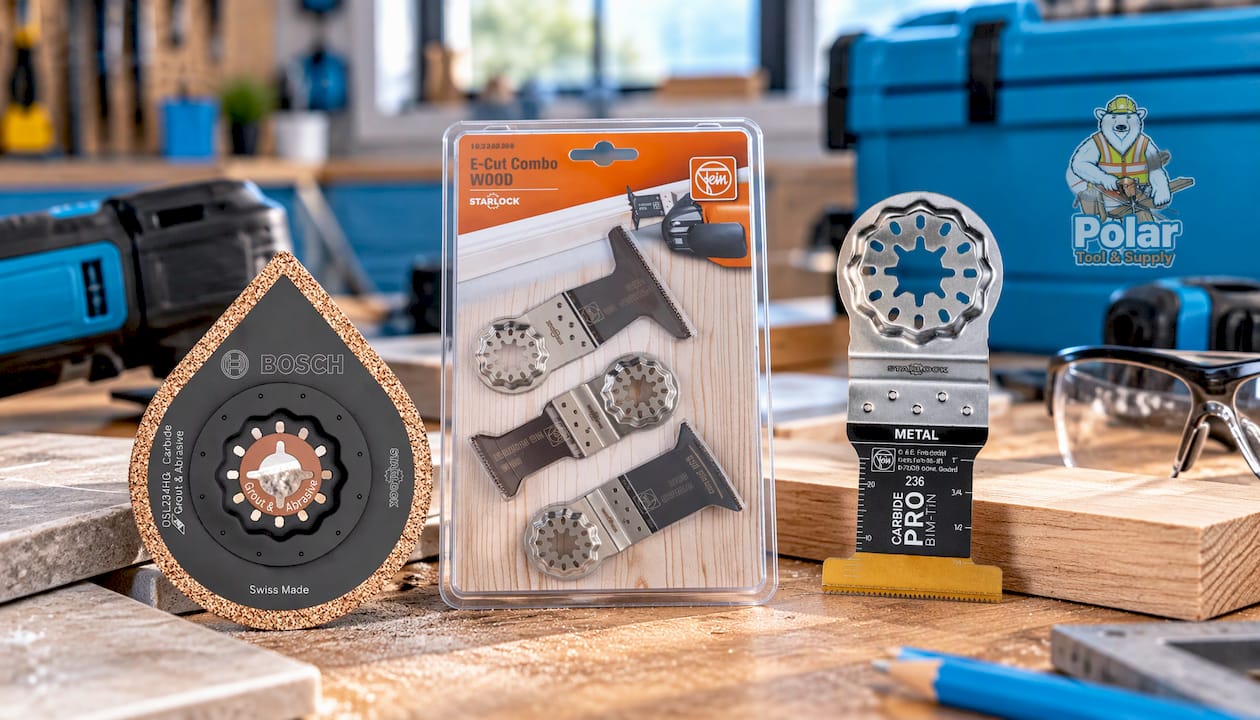
Wood blades have larger, more aggressive teeth for fast cuts in framing lumber, plywood and trim. Fein’s long-life wood blades, such as the E-Cut 160 and the E-Cut 161, use bi-metal teeth and are listed for all woods, drywall and plastic. If you want a few shapes in one purchase, the Fein E-Cut combo wood blade set covers common wood cuts together.
Metal and nail-embedded work
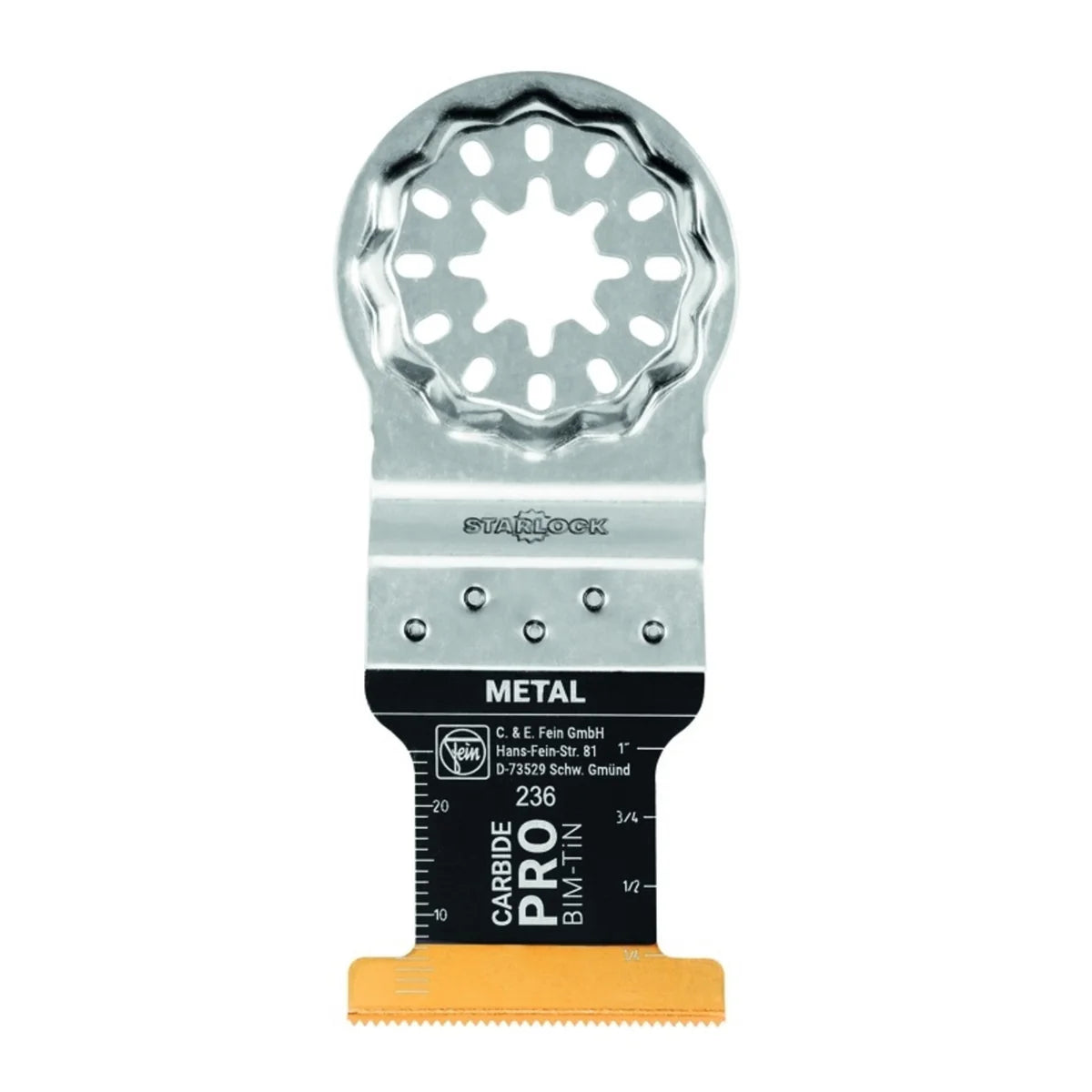
Bi-metal blades pair a flexible steel body with harder teeth, which is why they are the usual pick for wood with nails in it, such as remodel demolition. For tougher material, carbide is the step up. The Fein E-Cut Carbide Pro 3-pack is the one to look at when a bi-metal blade dulls quickly. For precision work in smaller sections, the E-Cut Precision bi-metal 50x50mm 3-pack gives you a compact blade.
Scrapers and sanding accessories
Scraper blades lift caulk, thinset, old flooring glue and paint. Sanding pads reach into corners that a sheet sander cannot. They are handy extras, though cutting and grout work account for most blade purchases.
Grout blades
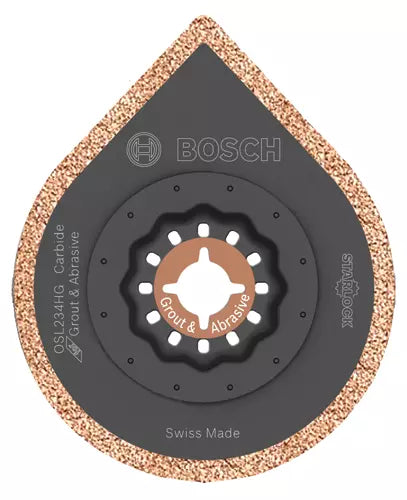
Grout is hard enough to burn through regular cutting blades. Consumer Reports explains that grout-removal blades are edged with carbide or diamond dust, that diamond is tougher than carbide and so costs more, and that these blades are essentially single-purpose. We carry a Starlock hybrid grout blade for exactly this job.
Fit: Starlock, universal and what the mount means
“Universal” on a package sounds like a promise. In practice it means the blade has a pattern or adapter that physically attaches to many tools. It does not mean every tool will run it well.
The Power Tool Institute tells users to verify that the accessory fits the tool’s spindle, because mismatched spindles wobble and vibrate and may cause loss of control. It also says not to use accessories that are not specifically designed and recommended by the tool manufacturer, even if they can be attached. Read that as a fit rule: check your tool’s manual for the accessory systems it lists, then buy to that list.
The Starlock family
Consumer Reports says most oscillating tools now use StarLock, StarLockPlus or StarLockMax tool-free attachment instead of the old bolt-and-clamp. Plus and Max have more contact points and fit larger, more aggressive blades. Many tools accept all three StarLock blade types, so check which ones yours takes.
A few practical points:
- Tool-free changes. You swap blades without a hex key, which matters when you change from a wood blade to a grout blade mid-job.
- Contact points. More contact points mean a more secure fit for heavy blades. If your tool is rated for Plus or Max, you can run the bigger blades. A tool built for plain StarLock is not rated for them.
- Older tools. If your tool has a bolt-and-clamp mount, look for blades listed for that mount rather than assuming a Starlock blade will work.
Do Fein blades fit other brands?
Often, with exceptions. Fein’s Starlock system was co-developed with Bosch. Woodshop News reported in 2016 that Fein’s Starlock accessories work with Bosch tools and are backward-compatible with MultiMaster tools made before April 1, 2016, and with some competitor tools. Fein itself says you always get the most precise cut using a Fein tool with a Fein blade.
JLC Online adds that Starlock blades are compatible with most other makers’ multi-tools, with exceptions. DeWalt, for example, requires a special adapter. If you own a DeWalt multi-tool such as the DCS356B 20V MAX XR brushless, confirm the exact blade pattern in its manual before you order a pack.
If you run a Fein tool, the MultiMaster 500 Plus pairs naturally with Fein’s own blades, and our MultiMaster 500 Plus review goes through how it performs.
Quick guide: which blade for which job
| Job | Blade type | Material to look for |
|---|---|---|
| Cutting an opening in drywall or plywood | Plunge-cut | Bi-metal |
| Trimming a door jamb or casing at the floor | Flush-cut | Bi-metal |
| Remodel work in wood with hidden nails | Plunge or straight | Bi-metal or carbide |
| General framing and trim cuts | Wood blade | Bi-metal, long-life teeth |
| Hard or abrasive material | Carbide blade | Carbide |
| Removing grout between tiles | Grout blade | Carbide or diamond edge |
Removing grout without damaging tile
Grout removal is the second most common reason people search for these blades, and it is the job where the wrong accessory costs you the most.
- Use a grout blade. A wood or metal blade dulls fast against grout. A carbide or diamond-edged blade is made for it.
- Choose the width to match the joint. A blade wider than the grout line will chew at the tile edges. Hold the blade in line with the joint, not at an angle.
- Let the tool run at full speed and guide it. This Old House recommends starting slowly to establish a kerf, which is the initial groove, then gently rocking the blade so more teeth engage. On a grout line, the same patience keeps the blade tracking in the joint.
- Take light passes. Heavy pressure does not speed things up. This Old House also advises backing off pressure and speed if you see smoke, since heat ruins accessories.
- Wear a respirator. Grout dust is fine and you will make plenty. The Power Tool Institute says to use the correct dust mask or respirator for the material you are cutting.
- Vacuum as you go. A clear joint lets you see where the blade is headed.
For tile regrouting jobs, the hybrid grout blade is the one to keep in the kit.

Using blades safely and getting the best life out of them
Accessory choice is a safety matter. The Power Tool Institute says that picking the correct tool and accessory for the application reduces the risk of serious injury, and that an accessory attaching to the tool does not assure safe operation.
Before you cut
The DeWalt DCS359 manual lists the basics, and the Power Tool Institute guide agrees:
- Wear ANSI Z87.1 eye protection, ANSI S12.6 hearing protection and NIOSH, OSHA or MSHA approved respiratory protection.
- Check for hidden wiring, gas lines and other utilities behind the surface. Use insulated grips if the blade could touch hidden wiring.
- Clamp the workpiece to a stable platform.
- Use suitable, undamaged blades.
- Confirm the switch works and keep hands and face away from the accessory.
Our safety gear category covers the eye, ear and respiratory protection you need before the first cut.
While you cut
- Let the tool reach full speed before touching the work.
- Avoid excessive pressure or depth, as the DeWalt manual advises.
- Lift the blade periodically to clear sawdust, and on vertical cuts work from the bottom up, as This Old House suggests.
- Mark depth with painter’s tape so you do not plunge deeper than intended.
After you cut
Wait for the blade to stop completely before setting the tool down. The blade and the workpiece are both hot. JLC Online points out that Starlock blade changes are a one-handed operation, which helps you avoid touching a hot blade, but let it cool anyway.
Pick the right tool for the rough work
This Old House suggests keeping the oscillating tool for detail work and finishing cuts, and using a circular or reciprocating saw for the initial rough cuts. That saves time and reduces wear on multi-tool blades. If you have a nail gun and compressor on the same job, you are already thinking in terms of the right tool for each stage. Blades are no different.
Stocking blades for a crew
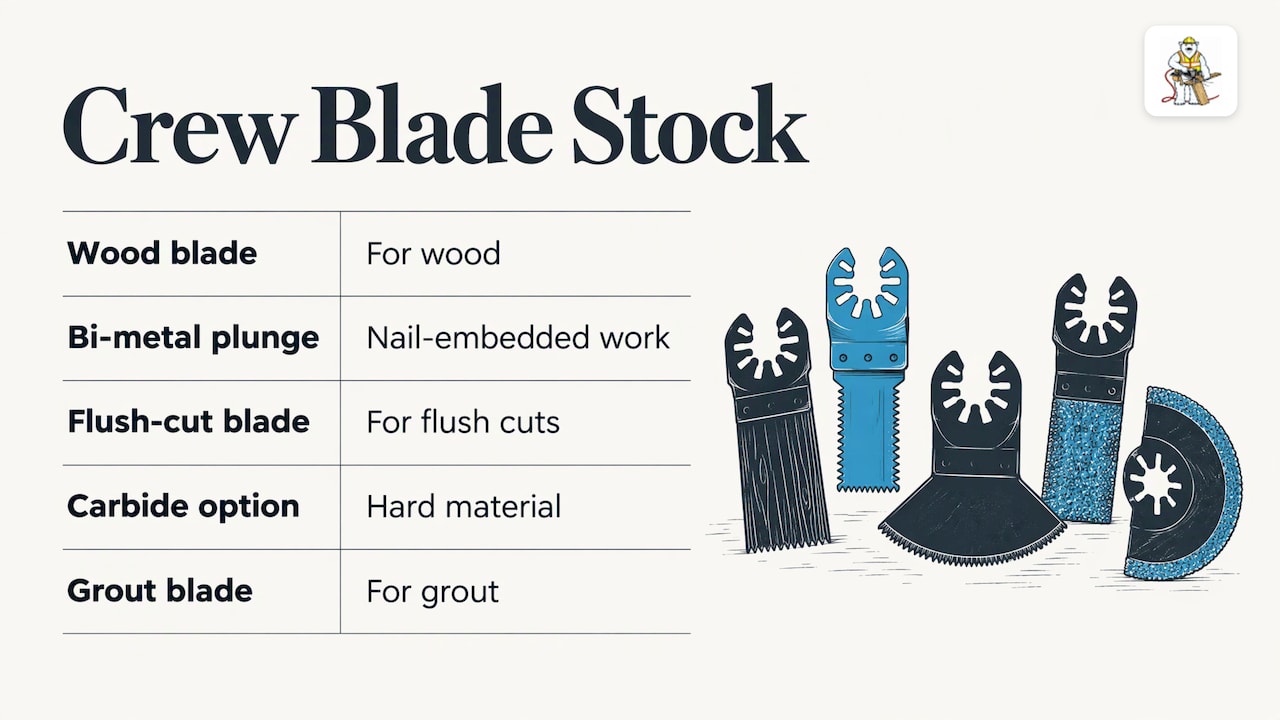
For a contractor, the blade you need is the one in the truck. A reasonable kit covers a wood blade, a bi-metal plunge blade for nail-embedded work, a flush-cut blade, a carbide option for hard material and a grout blade. Multi-packs make sense for the blades that wear fastest. Match every blade to the mount on every tool on the crew before you order, so a mixed fleet of brands does not leave anyone without a fitting blade.
Blades are only part of keeping tools productive. Batteries and abrasives are the other consumables that stop a job when they run out, and you can find both under our batteries and abrasives categories.
Getting the right blades from Polar Tool & Supply
We are a family-owned supplier that has served contractors, builders and homeowners since 2007. We carry blades alongside tools from Milwaukee, DeWalt, Makita, Metabo HPT and Stabila, so you can match accessories to the tool you own. Our staff can help you choose the right blade for your project, whether that is a flush cut at a door jamb or a grout line in a bathroom.
For local businesses, we offer free jobsite delivery within 50 miles of our business locations. If you are a contractor in Minnesota or Wisconsin and a crew is waiting on a blade pack, that means the supplies come to the site. Start with the Starlock hybrid grout blade, or browse the DeWalt and Bosch collections to match blades to your tools.
To order blades for your tool and arrange delivery to your jobsite, start at polartool.us.
FAQ
What is the best oscillating tool blade for cutting wood?
A wood blade with bi-metal teeth is the usual choice for lumber, plywood and trim. If the wood may contain nails, as in remodel work, a bi-metal or carbide blade holds up better. Single-material blades cut cleaner than multi-purpose ones, per Consumer Reports.
Are universal oscillating tool blades really universal?
Universal usually means the blade attaches to many tools, not that every tool is rated for it. The Power Tool Institute says to confirm the accessory fits the spindle and to use accessories the tool manufacturer recommends. Check your tool’s manual for its accepted blade systems before buying.
Do Fein multi-tool blades fit other brands?
Many do. Fein’s Starlock system was developed with Bosch, and Starlock blades work with most other makers’ tools. DeWalt tools are an example that needs a special adapter, according to JLC Online. Confirm your tool’s mount first.
What blade removes grout from tile?
Use a grout blade edged with carbide or diamond dust. Diamond is tougher and costs more, and these blades are essentially single-purpose. Choose a width that matches the joint, take light passes and wear a respirator.
Can I use an oscillating tool for rough cuts?
It can, but it is slower and wears blades faster. This Old House recommends saving the multi-tool for detail and finishing cuts and using a circular or reciprocating saw for the rough cutting.
Sources
- Oscillating Multi-Tool Buying Guide, Consumer Reports
- Multi-Tools and Oscillating Tools safety guide, Power Tool Institute
- Fein updates multitool and adds accessories, Woodshop News
- Fein Starlock MultiMaster Review, JLC Online
- DeWalt DCS359 instruction manual
- Tool Lab: How to Choose and Use Oscillating Multi-Tools, This Old House


